LASIK myths are everywhere. If you’ve been considering LASIK eye surgery, you’ve probably heard claims that the procedure is extremely painful, guarantees perfect vision, or is completely risk-free. But how much of what you hear about LASIK is actually true?
With so much information available online, it can be difficult to separate LASIK facts from fiction. Some common beliefs are based on outdated information, while others oversimplify what is actually a highly personalized medical procedure.
LASIK can be an effective vision-correction option for appropriately selected patients, but it isn’t right for everyone—and no surgical procedure should be described as completely risk-free.
In this guide, we’ll break down five common LASIK myths, explain what the evidence and clinical experience tell us, and highlight what you should know before deciding whether laser vision correction is right for you.
What Is LASIK Eye Surgery?
Before we discuss the myths, let’s understand what LASIK actually is.
LASIK, or Laser-Assisted In Situ Keratomileusis, is a type of refractive eye surgery designed to correct certain vision problems by reshaping the cornea.
The cornea is the clear, front surface of your eye. It helps focus incoming light onto the retina. If the shape of your eye or cornea causes light to focus incorrectly, you may experience blurry vision.
LASIK can be used to correct certain levels of:
- Myopia (nearsightedness)
- Hyperopia (farsightedness)
- Astigmatism
During LASIK, the surgeon uses specialized laser technology to reshape the corneal tissue so that light can focus more accurately on the retina.
The goal is generally to reduce dependence on glasses or contact lenses, rather than to promise that every patient will have perfect vision forever.
Now let’s tackle some of the most common misconceptions.
LASIK myths 1: LASIK Is Extremely Painful
One of the first questions many potential patients ask is:
“Does LASIK hurt?”
The fear of pain can be enough to stop someone from exploring laser vision correction altogether.
The reality: LASIK is generally performed using numbing eye drops.
Before the procedure begins, anesthetic eye drops are typically used to numb the surface of the eye.
During the procedure, patients may experience sensations such as pressure, touch, or a feeling that something is happening around the eye. The experience can be unusual, but significant pain during the procedure is not what most patients experience.
After surgery, however, your eyes may feel uncomfortable while they begin to recover.
Some people may experience:
- A gritty or sandy sensation
- Watery eyes
- Mild irritation
- Light sensitivity
- Dryness
- Temporary blurred or fluctuating vision
These symptoms can vary from person to person.
Your surgeon will provide specific aftercare instructions and may prescribe medications or eye drops depending on your individual situation.
Why do people think LASIK is painful?
Part of the fear comes from imagining that a laser is “cutting into the eye.”
In reality, LASIK is performed using a highly controlled surgical technique and specialized equipment. The eye is carefully positioned and monitored throughout the procedure.
That doesn’t mean you should assume there will be zero discomfort. Instead, it is better to have realistic expectations.
The takeaway
LASIK isn’t something you should expect to be extremely painful, but it is still surgery and temporary discomfort can occur.
If you’re worried about pain, discuss your concerns openly with your ophthalmologist before treatment.
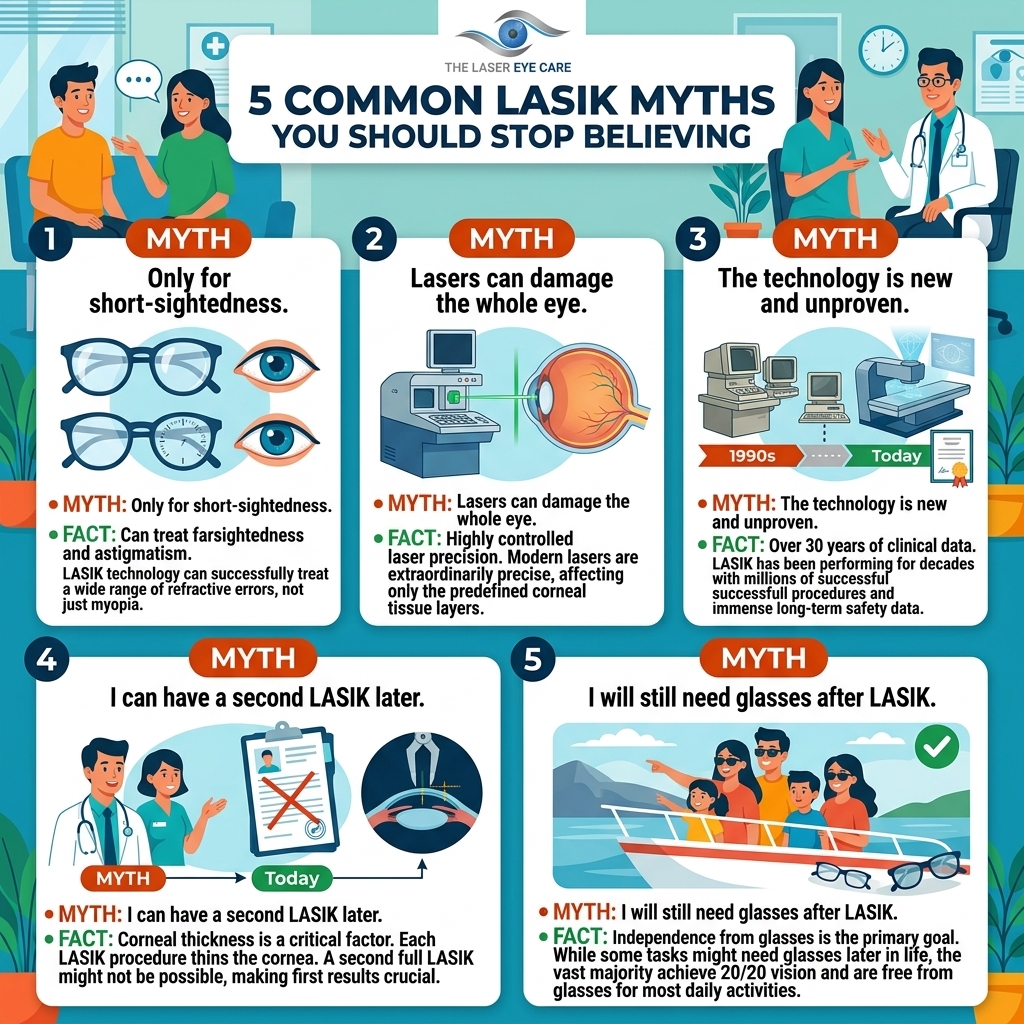
LASIK myths 2: LASIK Guarantees Perfect 20/20 Vision
This is one of the most important myths to understand.
You may see advertisements or social media posts suggesting that LASIK gives everyone perfect eyesight.
The reality: LASIK outcomes vary between individuals.
LASIK can provide excellent visual results for many appropriately selected patients, but no responsible surgeon can guarantee that every patient will achieve perfect 20/20 vision.
Your outcome may depend on several factors, including:
- Your original prescription
- Corneal shape
- Corneal thickness
- Overall eye health
- Age
- Healing response
- The type of refractive error
- The specific procedure recommended
Some patients may achieve excellent vision without glasses, while others may still require glasses for certain activities.
For example, you may find that you don’t need glasses for everyday distance vision but still prefer them for driving at night or performing a particular task.
What happens as you get older?
Another important point is that LASIK doesn’t stop the natural aging process of your eyes.
As people get older, the natural lens inside the eye gradually loses its ability to focus on nearby objects. This condition is known as presbyopia.
That means someone can have successful LASIK and excellent distance vision but later require reading glasses.
This isn’t necessarily a sign that LASIK “failed.” It is a natural age-related change.
The takeaway
LASIK can reduce dependence on glasses, but it should not be viewed as a guarantee of perfect vision for life.
A good consultation should focus on realistic expectations rather than promises.
LASIK myths 3: If You Have a High Prescription, You Can’t Have LASIK
If your glasses prescription is strong, you may assume laser eye surgery isn’t an option for you.
But eligibility isn’t determined by your prescription alone.
The reality: LASIK candidacy depends on several factors.
Your ophthalmologist may evaluate:
- Your current prescription
- Whether your prescription has remained stable
- Corneal thickness
- Corneal shape
- Tear-film and dry-eye status
- Overall eye health
- Previous eye conditions or surgeries
- Your age and general medical history
Some patients with higher prescriptions may be candidates for refractive surgery, while others may be advised against LASIK because of their individual eye characteristics.
What if you’re not suitable for LASIK?
Being told that LASIK isn’t suitable doesn’t necessarily mean you have no options.
Depending on your eyes and prescription, your ophthalmologist may discuss alternative forms of vision correction.
These can include other refractive procedures or, for some patients, lens-based options.
The important point is that there is no single vision-correction procedure that is right for everyone.
The takeaway
Don’t decide that you are—or aren’t—a LASIK candidate based solely on your glasses prescription.
A detailed eye examination is the best way to determine which options may be appropriate.
LASIK myths 4: LASIK Is Completely Risk-Free
This myth can go in two very different directions.
Some people believe LASIK is extremely dangerous.
Others believe it has absolutely no risks.
Neither view is accurate.
The reality: LASIK has potential risks and side effects.
LASIK is a surgical procedure, and every surgical procedure has potential risks.
Some patients may experience temporary or persistent visual symptoms such as:
- Dry eyes
- Glare
- Halos around lights
- Difficulty with night vision
- Fluctuating vision
- Visual disturbances
- Under-correction or over-correction
In some cases, additional treatment may be considered, while certain complications can be more serious.
This is why your pre-operative evaluation is so important.
Why is screening important?
Before recommending LASIK, an eye specialist can assess whether your eyes are suitable for the procedure.
Testing may evaluate aspects such as your corneal shape, corneal thickness, prescription, eye surface, and overall eye health.
The purpose isn’t simply to determine whether you want LASIK.
It’s to determine whether LASIK is a reasonable option for your individual eyes.
Be careful with “risk-free” promises
If a clinic or advertisement tells you that LASIK is completely risk-free, treat that statement cautiously.
A trustworthy consultation should explain both:
Potential benefits + potential risks + alternatives + realistic expectations.
The takeaway
LASIK can be an appropriate and effective option for many carefully selected patients, but it is not risk-free.
The right decision comes from understanding your individual risk profile rather than relying on blanket claims.
LASIK myths 5: After LASIK, You’ll Never Need Glasses Again
This sounds appealing:
“Get LASIK once and forget about glasses forever.”
But that’s not how vision works.
The reality: LASIK can reduce your dependence on glasses, but your eyes can still change.
LASIK reshapes the cornea to correct your existing refractive error.
It doesn’t prevent future changes in your eyes.
One of the most common examples is presbyopia.
As you age, your eye’s natural focusing ability changes, which can make reading and other close-up tasks more difficult.
Someone who had excellent distance vision after LASIK may eventually need reading glasses.
Your prescription can also change for other reasons.
Does needing glasses later mean LASIK failed?
Not necessarily.
If your eyes change years after LASIK, that doesn’t automatically mean the original procedure was unsuccessful.
LASIK addresses the refractive error present at the time of treatment. It cannot stop every future change that occurs in the eye.
The takeaway
Think of LASIK as a procedure that can reduce your dependence on corrective eyewear, rather than a guarantee that you will never wear glasses again.
Bonus Myth: LASIK Is the Same for Everyone
Although we’ve focused on five myths, there’s another misconception worth mentioning.
The reality: Your treatment should be based on your eyes.
LASIK is not a “one-size-fits-all” procedure.
Two people can have similar glasses prescriptions but very different corneal measurements, eye-surface health, or visual needs.
That’s why a proper consultation matters.
Your ophthalmologist should consider your:
- Vision goals
- Prescription
- Eye health
- Corneal measurements
- Lifestyle
- Expectations
- Previous eye history
The best treatment plan is one that is based on your individual needs—not someone else’s experience.
What Happens During a LASIK Consultation?
If you’re considering LASIK, the consultation is one of the most important steps.
Your eye specialist may perform a detailed examination to determine whether laser vision correction is appropriate.
The evaluation may include measurements of:
Your vision
Your prescription and visual acuity are assessed to understand your current level of refractive error.
Your cornea
The shape and thickness of your cornea can play an important role in determining whether LASIK is suitable.
Your eye surface
Dry-eye symptoms and tear-film health may be assessed because the condition of the eye surface can affect both suitability and recovery.
Your overall eye health
The ophthalmologist will look for conditions that could affect the safety or outcome of refractive surgery.
Your expectations
This part is often overlooked.
A good surgeon should understand why you want LASIK and what you expect from the procedure.
If your expectations are unrealistic, your doctor should explain what is and isn’t achievable.
LASIK vs. Glasses vs. Contact Lenses
LASIK isn’t automatically better than glasses or contact lenses.
Each option has advantages and disadvantages.
| Option | Main Advantage | Consideration |
|---|---|---|
| Glasses | Non-invasive and easy to use | Can be inconvenient during some activities |
| Contact lenses | Provide vision correction without glasses | Require regular hygiene and replacement |
| LASIK | May reduce dependence on glasses or contacts | Requires surgery and has potential risks |
The right choice depends on your lifestyle, preferences, eye health, and medical suitability.
For some people, glasses remain the simplest and safest choice.
For others, contact lenses work well.
And for appropriately selected patients, LASIK may offer an attractive alternative.
What Should You Ask Before LASIK Surgery?
Don’t be afraid to ask questions during your consultation.
Consider asking your ophthalmologist:
- Am I a suitable candidate for LASIK?
- What results can I realistically expect?
- Which vision-correction procedure is best for my eyes?
- What are the potential risks in my particular case?
- How long should recovery take?
- Could I still need glasses after surgery?
- Could I develop reading-vision problems as I age?
- What happens if my prescription changes later?
- What follow-up care will I need?
- What is included in the total treatment cost?
A good consultation shouldn’t feel like a sales presentation.
It should feel like an informed medical discussion.
How to Choose a LASIK Surgeon
Choosing the right surgeon is just as important as understanding the procedure.
When researching a LASIK clinic, consider:
Qualifications and experience
Look for an appropriately qualified ophthalmologist with experience in refractive surgery.
Technology and diagnostics
Ask what diagnostic technology is used to evaluate your eyes and determine whether you are suitable for treatment.
Transparency
Be cautious of clinics that make unrealistic promises about guaranteed results.
Patient education
A good clinic should explain the procedure, risks, alternatives, recovery, and expected results clearly.
Follow-up care
Ask what post-operative monitoring and follow-up appointments are included.
Individualized treatment
Your treatment should be based on your eyes and needs—not simply on a standard package.
Is LASIK Right for You?
If you’re tired of reaching for your glasses every morning or dealing with contact lenses, LASIK may be worth exploring.
But the decision shouldn’t be based on myths, advertisements, or another person’s experience.
LASIK is a medical procedure, and your eyes are unique.
The best first step is a comprehensive examination with a qualified ophthalmologist.
During that consultation, you can learn whether you’re a suitable candidate, what results you might realistically expect, what risks apply to you, and whether another treatment option would be more appropriate.
Final Thoughts: Look Beyond the Myths
LASIK has helped many people reduce their dependence on glasses and contact lenses, but understanding what the procedure can—and cannot—do is essential.
Let’s recap the five myths:
LASIK Myths 1: LASIK is extremely painful.
Fact: Numbing drops are used during the procedure, although temporary discomfort can occur during recovery.
LASIK Myths 2: LASIK guarantees perfect 20/20 vision.
Fact: Results vary, and some patients may still need glasses for certain activities.
LASIK Myths 3: People with higher prescriptions can’t have LASIK.
Fact: Eligibility depends on multiple factors, not prescription strength alone.
LASIK Myths 4: LASIK is completely risk-free.
Fact: LASIK has potential side effects and complications and should be considered after an appropriate evaluation.
LASIK Myths 5: You’ll never need glasses again.
Fact: LASIK can reduce dependence on glasses, but natural age-related vision changes can still occur.
Ultimately, the most important thing isn’t whether someone online says LASIK is “amazing” or “dangerous.”
It’s whether LASIK is appropriate for your individual eyes.
If you’re considering laser vision correction, schedule a comprehensive eye examination and discuss your options with a qualified ophthalmologist.
Because when it comes to your eyesight, the right decision starts with the right information.
Frequently Asked Questions About LASIK
Is LASIK painful?
LASIK is typically performed after numbing the eyes with anesthetic drops. You may experience pressure or unusual sensations during the procedure, and temporary discomfort, dryness, or irritation can occur afterward.
Does LASIK permanently improve vision?
LASIK permanently reshapes the cornea, but it doesn’t prevent natural changes to the eyes. Your vision can change over time, and you may eventually need glasses for certain activities.
Can LASIK correct astigmatism?
LASIK can correct certain types and degrees of astigmatism. Whether it is appropriate depends on your individual eye measurements and overall eye health.
Can I get LASIK if I have a high prescription?
Some people with higher prescriptions may be candidates, while others may not be. A comprehensive examination is necessary to determine suitability.
How long does LASIK recovery take?
Recovery varies between individuals. Many patients experience relatively quick visual improvement, but symptoms such as dryness or fluctuating vision can take longer to settle. Your surgeon will provide personalized recovery instructions.
What are the possible side effects of LASIK?
Potential side effects can include dry eyes, glare, halos, night-vision difficulties, fluctuating vision, and other visual symptoms. Your surgeon should discuss the risks relevant to your individual situation.
Is LASIK better than contact lenses?
Neither option is universally better. Contact lenses may work very well for some people, while LASIK may be preferable for appropriately selected patients who want to reduce their dependence on corrective lenses.
How do I know if I’m a good LASIK candidate?
The only reliable way to determine candidacy is through a comprehensive eye examination by a qualified eye-care professional.